
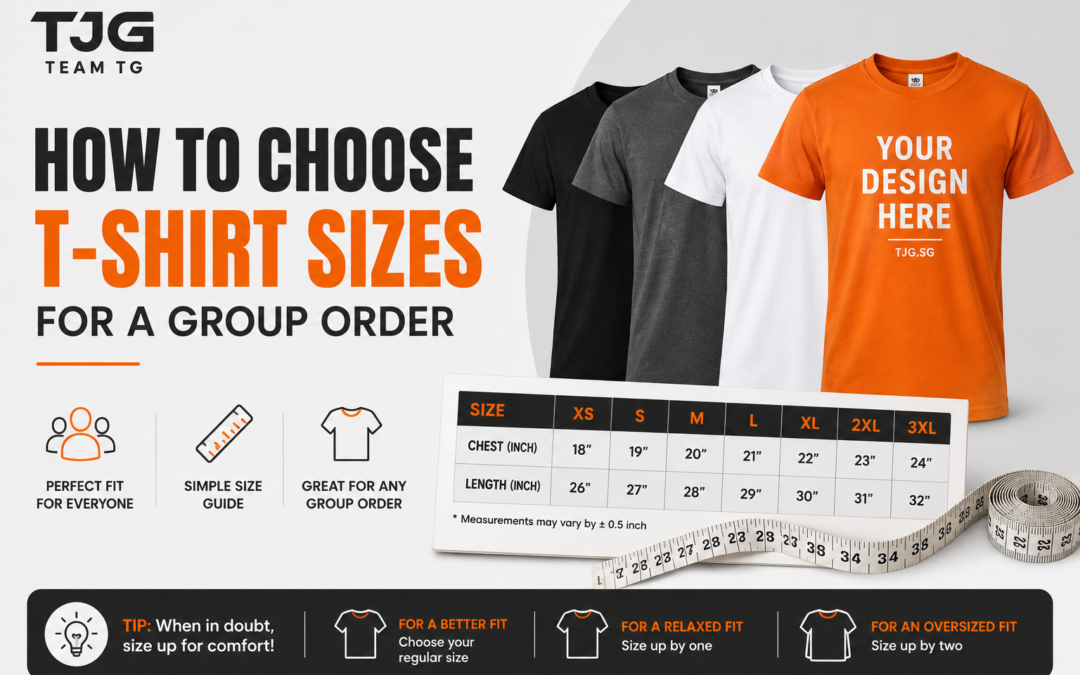
Ordering T-shirts for a group sounds simple until everyone starts asking, “What size should I choose?”
Some people prefer a relaxed fit, others want a regular fit, and a few may not confirm their sizes before the ordering deadline.
Whether you’re ordering 50 shirts for a school activity or 100 for a company event, getting the size breakdown right can help you avoid unnecessary costs and last-minute changes.
If you’re planning custom T-shirt printing in Singapore, collecting accurate size details early can make the entire ordering process much easier.
This guide explains how to collect sizes, calculate quantities and plan your group T-shirt order with greater confidence.
Example T-Shirt Size Breakdown for 50 and 100 Shirts
If you’re organising a group order, the first step is to find out which sizes your participants need.
The table below shows two example distributions to help you understand how a bulk order might be divided.
|
Size |
50 shirts |
100 shirts |
|
S |
6 |
12 |
|
M |
15 |
30 |
|
L |
16 |
32 |
|
XL |
9 |
18 |
|
XXL |
4 |
8 |
|
Total |
50 |
100 |
Important:These are illustrative examples, not recommended size ratios for every group. Actual requirements will depend on your participants, garment style and supplier’s size chart.
If you haven’t decided how many custom T-shirts to order for an event, read our guide on before finalising your size breakdown.
Why Sizing Matters More in a Group Order
Ordering T-shirts in bulk means choosing sizes for an entire group at once. Whether you’re arranging company shirts or class T-shirt printing, changing sizes after printing has started can mean extra costs or shirts that cannot be used.
Getting the quantities wrong can mean:
- Too many shirts in sizes that few people requested
- Not enough XL, XXL or larger sizes
- Confusion over regular versus oversized fits
- Sizing problems when different brands use different measurements
- Extra costs if you need to reorder shirts
Follow these steps to choose T-shirt sizes for a group.
Step 1: Get the T-shirt size chart for the exact shirt
Ask your supplier for the size chart of the specific T-shirt you plan to order. Don’t rely on a generic chart. An M from one brand can be wider or longer than an M from another.
Look for two measurements in particular:
- Chest width: how wide the shirt is across the chest
- Body length: how long it is from shoulder to hem
Some charts list these laid flat, and others list the body measurement, so check which one your supplier uses before anyone starts comparing.
Step 2. Ask everyone to check their size
Share the supplier’s size chart with the group. Ask everyone to compare the size chart measurements with a T-shirt they already own and like. This gives them a more reliable way to choose a size than relying on the label they usually wear.
Step 3: Collect sizes by a single deadline
When sizes come in through different WhatsApp groups and private messages, it’s easy to overlook a reply or note down the wrong size.
Ask everyone to submit their size through one Google Form or a pinned WhatsApp poll, with one deadline for responses.
Ask each person for:
- Name
- T-shirt size
- Quantity needed
- Preferred fit (optional)
- Remarks for unusual sizing (optional)
Step 4: Count the responses
Once the deadline passes, calculate how many people chose each size. Then check that the total matches the number of people who are supposed to get a shirt. If it doesn’t, someone is missing or has been counted twice.
Here’s what a confirmed count might look like for a group of 70:
- S – 8
- M – 22
- L – 25
- XL – 12
- XXL – 3
These figures show the sizes your group has requested, giving you a clearer basis for planning production.
If everyone has confirmed their size, you’re done.
Step 5. Estimate Sizes When Responses Are Missing
For large group orders, you may need to prepare an initial size estimate before everyone has responded.
Start by calculating the percentage of confirmed responses for each size. You can then apply those percentages to the planned order quantity.
Formula:
Estimated shirts per size = (Responses for that size ÷ Total responses) × Planned order quantity
For example, if 8 out of 70 respondents choose size S, and you’re planning an order of 1,200 shirts:
(8 ÷ 70) × 1,200 = 137.14
This gives an initial estimate of approximately 137 size-S shirts.
However, an estimate based on only 70 responses for 1,200 recipients may be unreliable. Before confirming production, collect more responses where possible and check whether different departments, classes or teams have different sizing needs.
If you need to round estimated quantities, adjust the final figures so the size totals match the planned order.
Tip: Keep confirmed sizes separate from estimated sizes in your spreadsheet. This makes it easier to identify which quantities still need verification.
How to Choose Sizes for Men’s, Women’s and Mixed Groups
- Men’s groups: Men’s T-shirt sizes vary by brand and style. Check the chest and length measurements instead of relying on someone’s usual size.
- Women’s groups: Check whether the selected T-shirt has a women’s cut or a unisex fit. Different cuts can affect the fit even when the size label is the same.
- Mixed groups: Let each person choose from the same garment’s size chart instead of automatically converting between men’s and women’s sizes.
- Oversized T-shirts: Check the Oversized T-shirt collection before sizing up, as the design may already offer a loose fit.
Regardless of your group’s composition, check the garment measurements rather than relying solely on generic S, M, L, or XL labels.
What If People Don’t Submit Their Size?
Some people may miss the deadline, especially in a large group.
Send one reminder before finalising the order.
For anyone who still hasn’t responded, check their measurement or a size record from the same T-shirt style if available. Otherwise, mark the size as an estimate rather than a confirmed choice.
For large orders, use the responses received to estimate missing quantities, but remember that the estimate may be inaccurate if the people who haven’t replied have different sizing needs.
Final Group T-Shirt Size Checklist
- The correct T-shirt size chart has been shared.
- Participants have checked the garment measurements.
- The regular, relaxed or oversized fit has been explained.
- Confirmed sizes and estimated sizes are recorded separately.
- Required XXL, 3XL or larger sizes are included.
- The quantities add up to the total order.
- The final breakdown has been checked before production.
Common mistakes to avoid
- Ordering only M and L: It feels like the safe choice, but it leaves your smallest and largest people without a shirt that fits.
- Skipping the size chart. S, M, L and XL can fit differently, so check the actual measurements before choosing the size.
- Ordering too many extras: Consider a small buffer if your group expects late additions or replacement shirts.
- Not planning for size exchanges: Decide in advance how exchanges will be handled. Contact your supplier early to confirm the available options and terms.
- Using the same artwork for products: If you order both a tee and a hoodie, check T-shirt design tips for more information.
Get a Quote for Your Group T-Shirt Order
Once you’ve confirmed size, the next step is choosing a T-shirt that suits your group, budget and deadline.
Browse TJG Print T-shirt catalogue to compare available styles and check each product’s size chart before placing your order.
For ready-stock apparel, eligible orders can include mixed sizes under the same design. Check product availability and any additional charges for larger sizes before confirming your quantities.
Ready to proceed? Send us your design, estimated quantity, size breakdown and required delivery date to request a quote.
We’ll help you work out the next steps for your group T-shirt order.
People Also Ask
Could 2XL and larger sizes cost more?
Check the T-shirt printing cost guide before placing your order, as a few larger sizes can increase the total cost.
How do you decide T-shirt sizes for a large group?
For a very large group, collect sizes using the supplier’s shirt size chart and use the confirmed responses to create your T-shirt size breakdown.
Why should Singapore groups check T-shirt fabric?
Different T-shirt materials feel and fit differently, especially in Singapore’s hot and humid weather. Check the fabric before ordering so the group gets shirts that feel comfortable to wear.
Can I mix sizes in one order?
Yes. TJG Print allows mixed sizes under the same design on its ready-stock apparel at the same price per piece. Confirm the available sizes and terms for your selected product.
What's the safest size to order if I don't have everyone's sizes?
Every group has different size requirements. Use the sizes people have confirmed to estimate the remaining quantities and check whether the unanswered participants have different sizing needs. Avoid ordering only M and L based on assumptions.