
Logo placement is not just about aesthetics.
Where you put a logo can change the way people notice it and the impression the shirt creates. A small logo on the left chest can look professional and understated, while a large design across the centre or back can make the branding much harder to miss.
Even a small change in logo position can affect the overall balance of the design.
So, before you pick a spot for your logo, think about what you want the custom T-shirt printing to say and how much attention you want the logo to get.
In this guide, we’ll look at where to place a logo on a T-shirt, including the left chest, centre, back and other common spots, so you can decide where your logo should go.
Where Should You Put a Logo on a T-Shirt?
For most custom T-shirts, these are the main options:
|
Placement |
Typical size |
Best For |
|
Left chest |
6–13cm wide |
Company logos, school and staff shirts |
|
Centre chest |
15–25cm wide |
Logos needing more visibility |
|
Full front |
Up to 28cm x 38cm |
Large artwork and statement designs |
|
Upper back |
10–12cm wide |
Team names and event branding |
|
Full back |
Up to 28cm x 38cm |
Large graphics and slogans |
|
Sleeve |
5-7cm wide |
Sponsors and secondary logos |
|
Near collar |
10-12cm wide |
Small, subtle brand marks |
|
Near hem |
10-12cm in wide |
Modern, understated branding |
There is no fixed best logo placement on T-shirts for every order. The right choice depends on four things:
- Who sees it: customers, colleagues, a crowd or the public
- How big the logo is: a small icon or a full design
- The shirt: cotton tee, Dri Fit, polo or jacket
- The print method: silkscreen, DTF or embroidery
Why Logo Position Matters?
Choosing a logo placement goes beyond appearance. The right position makes your design easier to see and keeps the T-shirt looking balanced.
Good custom T-shirt logo placement should consider:
- Logo size
- T-shirt size
- Garment style
- Printing method
- Design complexity
- Intended use
- Visibility
- Number of print locations
- Budget
- Whether the shirt will be worn casually, professionally or for an event
The placement also needs to work across different sizes. For example, a design that looks balanced on an adult M may need adjustment on an XS or 3XL shirt.
T-Shirt Logo Placement Guide: The Main Positions
Here are the common spots, with typical measurements.
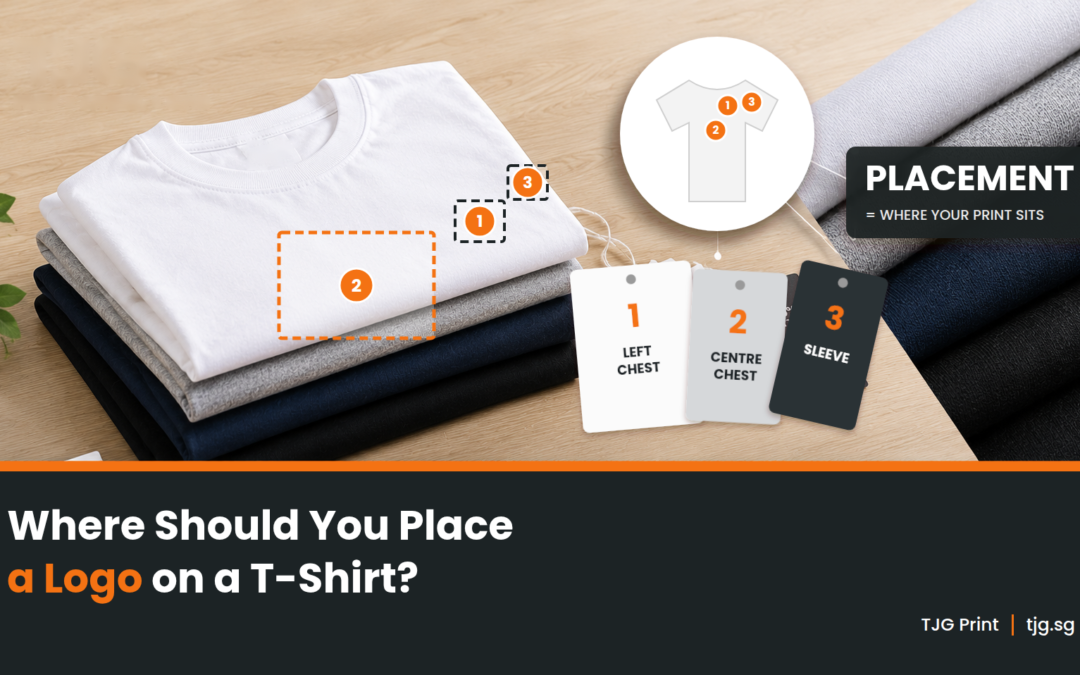
1. Left Chest Logo Placement
The left chest is a popular choice when you want a clean, professional look. It is often used for company T-shirts, staff uniforms, corporate events, school activity shirts, volunteer shirts, team and club apparel, and promotional T-shirts.
- Position: about 7.5cm (3″) below the neckline, and about 5cm (2″) in from the armpit seam
- Typical size: 6.4cm to 12.7cm wide (2.5″ to 5″)
- Embroidery limit: around 10cm × 10cm (4″ × 4″)
Note: It gives the shirt a clean appearance without making the branding feel oversized. It is ideal for brand identification rather than creating a large graphic.
2. Centre Chest Logo Placement
The centre chest gives a logo more presence than a traditional left-chest print. It suits wordmarks, longer names and simple artwork.
- Position: about 7.5cm to 9cm (3″ to 3.5″) below the collar, centred on the shirt.
- Typical size: 15cm × 15cm up to 25cm × 20cm (6″ × 6″ to 10″ × 8″)
- Most common: around 20cm × 20cm (8″ × 8″)
- Best for: event T-shirts, class tees, community runs, brand launches
3. Full Front Logo Placement
A full front placement gives bold graphics, large mascots and statement design. Often it includes the event name, illustration, date, slogan and other supporting elements.
- Position: about 7.5cm to 10cm (3″ to 4″) below the collar
- Typical maximum: around 30cm × 40cm (12″ × 16″) on most standard tees
- Best for: Event merchandise, sports teams, school camps, charity campaigns, product launches, brand merchandise, and group T-shirts.
Note: Bigger prints aren’t always the right choice. They also require clean, high-quality artwork files. Logo size limits depend on the product and printing method.
4. Back Logo Location
The back is a go-to option, especially for team shirts, volunteer tees and event crews.
- Upper back: high between the shoulder blades, good for a logo or event name
- Full back: typically up to about 25cm × 30cm (10″ × 12″) to 30cm × 40cm (12″ × 16″), depending on the shirt
- Best for: Event name, year, slogan, sponsor logos, website or social handle
This setup works well for event shirts because the front remains clean while the back carries the larger message.
5. Sleeve Logo Placement
If you want to keep the chest area simple, you can use a smaller logo or sponsor mark on the sleeve because it is narrow and ideal for simple artwork.
- Typical size: about 10cm × 9cm (4″ × 3.5″) as a standard maximum
- Best for: a sponsor logo, a small brand mark, a school crest or a team name
- Tip: keep it simple, and keep it clear of the hem and shoulder seam
A simple combination
- Left chest: Main logo
- Sleeve: Small event or team mark
Important: Sleeve printing varies between T-shirts and printers, so check the available print space before finalising your artwork.
6. Neck Label and Other Spots
Inside neck labels and small outside labels let you add your brand name or logo without taking up space on the main design. They work well for subtle branding on company, event and promotional T-shirts.
Print Method Changes the Placement
- Silkscreen printing suits simple, few-colour logos and larger bulk orders. It’s economical at volume.
- DTF printing handles gradients, fine detail and full-colour logos.
- Embroidery looks premium on polos, caps and jackets, but works best with smaller, simpler logos.
Where Should You Place a Logo on a T-Shirt for Men?
A men’s oversized T-shirt, fitted T-shirt and regular-cut T-shirt do not have the same visual proportions.
Like for a men’s corporate or team T-shirt, a left-chest logo is usually a safe starting point, while for a larger graphic, centre chest or full front gives the artwork more room.
Do not choose the placement based only on the wearer being male or female. Look at the actual garment dimensions, cut and size range.
A few practical points:
- Size: A logo may look different on a size M and an XXL. For different T-shirt sizes, keep the brand mark at the same distance from the collar and make small size adjustments where needed.
- Women’s cuts are narrower. If a group order includes women’s sizes, a very wide logo can wrap awkwardly. Check the mockup on both fits.
- Polos and collars. On a polo, the left chest sits below the placket and collar line, so it needs different spacing from a round-neck tee.
Unsure about the logo size or position? Ask TJG Printing for a digital mockup before confirming your order. We’ll send one for you to review.
How to Choose and Finalise Your T-Shirt Logo Placement
When ordering custom T-shirts in Singapore from TJG Print, you can follow these steps:
- Choose the T-shirt: Select the right T-shirt style for your group, such as cotton, Dri-Fit, polo or other apparel. Confirm the colour, fabric and quantity before deciding where to place your logo.
- Prepare your logo: Submit your logo or artwork in an accepted format such as AI, PNG, or PDF. TJG Print recommends high-resolution artwork of at least 300 dpi for print quality.
- Choose the logo position: TJG Print lists left chest, right chest, upper back and sleeves as common logo placement options. Choose the position that best suits your design and T-shirt purpose
- Decide Print Size: Choose the print dimensions that suit your artwork. TJG Print lists options such as a 9 × 7 cm logo print, an A4 print, and an A3 print. Confirm the final dimensions and price with the team before approving the design.
- Select the printing method: Depending on your logo, fabric and quantity, choose from silkscreen, DTF, sublimation, digital heat transfer or embroidery.
- Check the digital mockup: TJG Print in Singapore provides a digital mockup before bulk production to show how the logo is positioned
- Approve & print: Once you approve the artwork, TJG Print proceeds with the order. For ready-stock items, TJG currently states that T-shirt orders can be completed within 5 working days after artwork approval, while made-to-order customisation typically takes a minimum of 3 weeks.
Get Your Logo Placed Right
A T-shirt logo needs more than a good-looking design. Its size, placement and printing method also affect how it appears on the finished shirt.
If you’re planning custom-printed T-shirts in Singapore for a team, school, company or event, TJG Print in Singapore helps you choose the position, size and print method, and shows you a mockup first.
Since 2015, TJG Print has supported Singapore businesses, schools, and event organizers with customizable apparel and other promotional products.
Request a Quote or WhatsApp us at +65 8774 0792. If your deadline is tight, see our express T-shirt printing options.
People Also Ask
What is the best position for a logo on a T-shirt?
For most logos, the left chest is the safest pick. It looks neat and works on almost any shirt. For bigger designs, go for the centre chest or back.
Should a company logo go on the left or right chest?
The left chest is commonly used for company logos on uniforms. If you have a second logo, such as a sponsor’s, you can place it on the right chest. Use a mockup to check the spacing, size and position before printing.
What is the best T-shirt logo placement for branding?
Use a small logo on the left chest for everyday wear and a larger design on the back for events. This keeps the front simple while giving your design more space on the back. Our corporate uniform printing team can prepare a mockup showing both options.
How far down should a logo be placed on the chest?
Around 7.5cm to 10cm (3″ to 4″) below the collar is a common range. Adjust a little for each shirt size, and always check the mockup before we print.
Can you put a logo on the sleeve or back of a t-shirt?
Yes, both work well. Sleeves suit small logos or sponsors, and the back is great for team names and big prints. Extra print positions may change the price, so request a quote with your design.