
Imagine you’re organizing shirts for your department’s annual retreat. You pick a design, settle on a color, and start comparing options. Then you hit a product listing that says “180 GSM” and another that says “150 GSM.” Your colleague asks which one is better, and you realize you have no idea what the number actually means. You just know that nobody wants to be the person who ordered 60 shirts that feel like paper, or ones so thick that everyone is sweating through the opening speech.
If that sounds familiar, you are not alone. GSM is one of the most common terms in the shirt printing world, and one of the least explained. Here is a plain-language guide from us at TJG, so you can choose with confidence the next time you order for a class, a team or a company event in Singapore.
What Does GSM Mean?
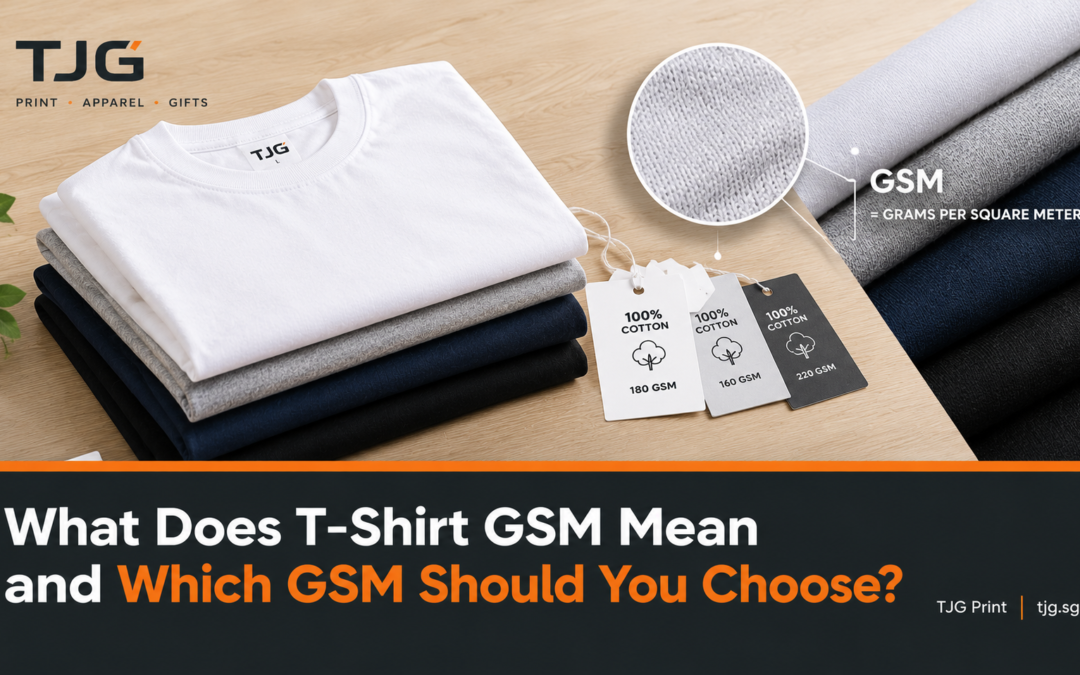
GSM stands for grams per square meter. It tells you how much a piece of fabric weighs for each square meter of material. A higher number means the fabric is heavier and usually thicker. A lower number means it is lighter and usually thinner.
Think of it like the weight of paper. Everyday printer paper feels light and flexible, while cardstock feels sturdier and holds its shape. Fabric works in a similar way. A 140 GSM shirt will drape and feel lighter on the body, while a 200 GSM shirt will feel firmer and more substantial.
One thing worth knowing is that GSM measures the fabric, not the finished shirt. So it says nothing about how big the shirt is. A small and an extra large in the same fabric have the same GSM.
A Rough Guide to GSM Ranges
Each one of t-shirt printing Singapore suppliers use slightly different labels, but these ranges are a helpful starting point:
|
GSM range |
Typical feel |
Common use |
|
Around 120 to 150 |
Light and airy |
Sports shirts, running events, hot outdoor days |
|
Around 150 to 180 |
Medium weight |
Everyday wear, class tees, company events |
|
Around 180 to 220 |
Heavier and sturdier |
Premium everyday tees, staff uniforms |
|
220 and above |
Thick and structured |
Oversized styles, streetwear, hoodies and sweatshirts |
Treat these as general guidelines rather than strict rules. The exact figure for any specific shirt depends on the product, so it is always worth asking for the fabric specification of the item you are considering.
Why GSM Matters for Your Order
GSM affects more than how a shirt feels in your hand. It changes the experience of wearing, printing and caring for it.
- Comfort in Singapore’s weather: Our climate is hot and humid all year, and that makes fabric weight a real consideration. Lighter fabrics tend to feel cooler and dry faster. Heavier fabrics can feel warmer, which matters if your group will be outdoors for hours, like on sports day or during a roadshow.
- Durability: In general, a heavier fabric holds its shape better after repeated washing and wearing. If your shirts will be worn often, such as staff uniforms or CCA tees that last a few years, a sturdier weight can be worth it.
- Opacity: Lighter fabrics, especially in white or pale colors, can look a bit see-through. If you are ordering light-colored shirts for a large group, a slightly heavier weight can give a more comfortable, less revealing result.
- Look and drape: A lighter shirt tends to drape softly, while a heavier one sits with more structure. That is why oversized and streetwear styles often use higher GSM fabrics, since the weight helps the shirt hang well.
- Price: More fabric generally means a higher cost. If you are working within a tight budget, choosing a medium weight can give you a good balance between feel and cost.
GSM and Printing: Does It Make a Difference?
Yes, it can. The right printing method depends on both your design and your fabric.
- Silkscreen printing works well across a wide range of cotton shirts and is a popular choice for bulk orders because it is economical at larger quantities.
- DTF printing suits detailed and multicolor artwork and handles a variety of fabrics.
- Dye sublimation is designed for polyester, so it is the usual choice for full-color, edge-to-edge designs on sports shirts and jerseys.
- Embroidery needs a fabric with enough body to hold the stitches neatly. This is why polos and heavier shirts are common choices for embroidered corporate wear.
If your design has large solid print areas, a very thin fabric can feel stiff under the ink. A medium or heavier weight often carries a big print more comfortably. If you are unsure, our team can recommend a pairing based on your artwork and quantity.
GSM Is Not the Whole Story
Here is something many guides skip: two shirts with the same GSM can feel completely different. That is because the number only tells you about weight, not quality or construction.
Other things that change how a shirt feels include:
- The fiber: Cotton, polyester and blends each behave differently. A 160 GSM cotton shirt feels very unlike a 160 GSM Dri Fit shirt.
- The knit and finish: How the fabric is knitted and treated affects softness, stretch and how it feels against the skin.
- The cut: A relaxed or oversized cut can make a shirt feel lighter or heavier than its number suggests.
So use GSM as one helpful clue, not the final answer. If you can, feel a sample in person. TJG welcomes appointments to view samples, which is the easiest way to compare weights side by side.
Which GSM Should You Choose?
The best choice depends on who is wearing the shirt and what they will be doing. Here are some common situations:
- Sports days, runs and active events: Go for lighter, breathable fabric. Dri Fit shirts are popular here because they are made for moisture management, which helps in Singapore’s humidity.
- Class and CCA shirts: A medium weight cotton or Dri Fit shirt is a reliable choice. It is comfortable for long days at school, holds up well to repeated washing and keeps costs reasonable for a big group.
- Company events and everyday staff wear: A medium to slightly heavier cotton tee gives a neat, professional feel. For a more premium impression, you might consider a sturdier weight.
- Corporate uniforms and embroidered shirts: Polos in a medium to heavier weight tend to hold embroidery well and keep a crisp shape throughout the day.
- Oversized and streetwear styles: These styles are usually made in heavier fabric so the shirt drapes well. If your brand wants that relaxed, structured look, a higher GSM is worth considering.
- Giveaways and one-time events: If shirts are mainly for an event day, a lighter weight can help you stay within budget while still looking good.
A Quick Decision Checklist
Before you choose, ask yourself:
- Will people be outdoors or active for long periods?
- How often will the shirts be worn and washed?
- Is the shirt a light color that might look see-through?
- What printing method does my design need?
- What is my budget per piece?
Your answers will usually point you toward the right weight without much guesswork.
Let TJG Help You Choose
If the numbers still feel confusing, you do not have to sort it out alone. Tell us about your group, your event and your budget, and our team will suggest a fabric and print method that fits. You can reach us through our website, by email at sales@tjg.sg, or by WhatsApp at +65 8774 0792. We aim to reply within one business hour, and we are happy to arrange a sample viewing by appointment.
Frequently Asked Questions
1. What is a good GSM for a T-shirt?
There is no single best number. A medium weight, roughly in the 150 to 180 range, is a popular all-round choice for everyday wear, class shirts and company events. Lighter fabrics suit sports and hot outdoor use, while heavier fabrics suit premium or oversized styles.
2. Is a higher GSM always better?
Not necessarily. Higher GSM means a heavier, sturdier fabric, but that can feel warm in Singapore’s climate and usually costs more. The best GSM is the one that suits how and where the shirt will be worn.
3. Does GSM affect print quality?
It can influence how a print feels and sits on the fabric, especially for large designs. The printing method also matters. Silkscreen and DTF work on many fabrics, while sublimation is made for polyester. Our team can recommend the best match for your artwork.
4. How do I find the GSM of a TJG product?
Ask our team for the fabric specification of the exact product you are considering, since details differ between styles. You can also book an appointment to view and feel samples before ordering.
5. Are Dri Fit shirts lighter than cotton shirts?
Dri Fit shirts are typically made from polyester and are designed to feel light and breathable, which is why they are popular for sports and hot weather. However, weight varies by product, so it is best to check the specification of the specific style you want.