
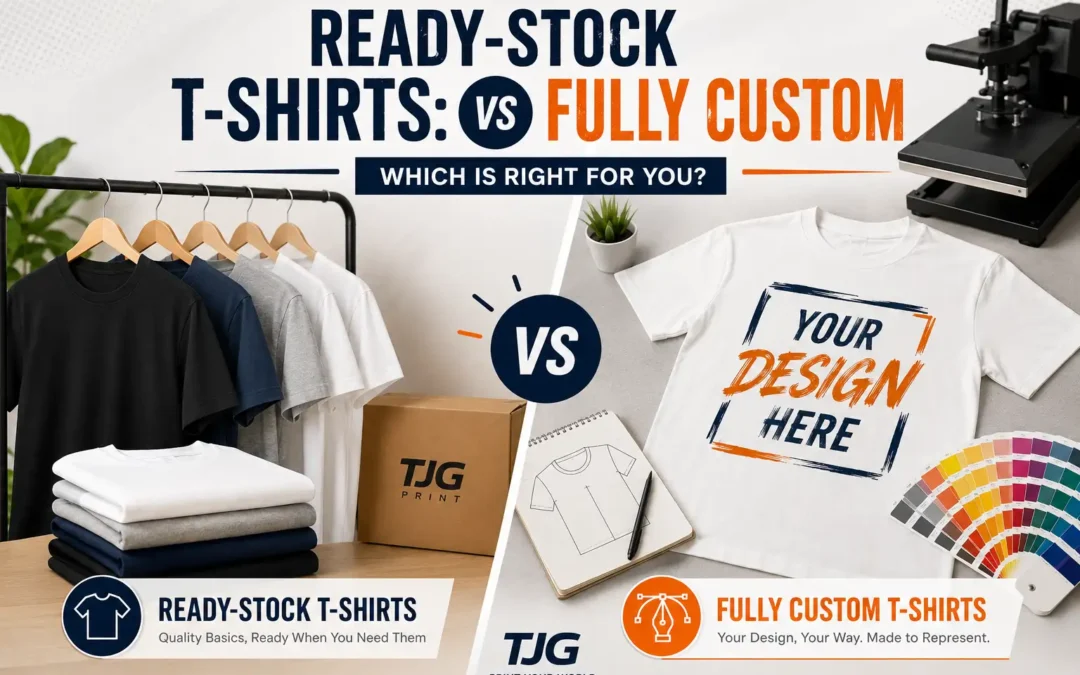
You have a design, a headcount and a deadline. Now comes the first big decision: do you print on existing T-shirts, or do you build the shirt from scratch?
It sounds like a small choice, but it affects your budget, your timeline and how the final shirt looks and feels. Many first-time buyers in Singapore assume “custom” always means a fully tailored garment. In reality, most orders for Custom T-Shirts are printed on ready-stock apparel, and that works well for the majority of schools, companies and event organizers.
This guide breaks down both options in plain terms so you can pick the one that fits your project, not the one that sounds fancier.
What Are Ready-Stock T-Shirts?
Ready-stock T-shirts are blank garments that a printer already carries in inventory. You pick a style, a color and your sizes, then the printer adds your design using a method like silkscreen, DTF or embroidery.
Think of it like choosing from a well-organized catalog. The shirt itself is already made, so you are only customizing what goes on it. At TJG, that catalog includes cotton tees, Dri Fit tees, polos, hoodies, windbreakers and more, with hundreds of products to choose from.
What you control: the garment style from the available range, the color, the sizes, and the print design, size and placement.
What you do not control: the cut, the fabric blend, the collar details or the exact shade of fabric. Those are fixed by the blank.
What Are Fully Custom T-Shirts?
Fully custom T-shirts, sometimes called custom-made or cut-and-sew apparel, are produced from scratch to your specifications. Instead of choosing from existing blanks, you decide the fabric, the color, the collar style, the piping, the panel layout and even the stitching details.
This route is common for school jackets, signature corporate uniforms and sports teams that want a one-of-a-kind look. Because the garment is manufactured for your order, there is more planning involved and a higher minimum quantity. At TJG, custom-made orders start from a minimum of 30 pieces.
What you control: nearly everything, from fabric to fit to finishing.
What you give up: speed and flexibility. Production takes longer, and the budget needs to be larger.
Ready-Stock vs Fully Custom: A Quick Comparison
| Ready-Stock | Fully Custom | |
| Minimum order | From 10 pieces per design | From 30 pieces |
| Turnaround | As fast as 5 working days after artwork approval | Roughly 3 to 5 weeks |
| Design freedom | Print design, size and placement | Fabric, color, cut, collar, piping and print |
| Cost per piece | Lower, with bulk discounts | Higher, since it is made to order |
| Best for | Class tees, events, staff uniforms, giveaways | Signature uniforms, school jackets, team kits |
If you only need a quick look, that table covers most of the decision. The sections below explain the reasoning so you can apply it to your own project.
When Ready-Stock Is the Smarter Pick
For most buyers, ready-stock is the practical choice. Here is when it makes the most sense.
You are working with a tight deadline
Event dates in Singapore do not move. If your orientation camp, company dinner or sports day is a few weeks away, ready-stock gives you the shortest path from design to delivery. Some orders can even be completed within days when you need a rush.
Your quantity is small to medium
Ready-stock printing starts from just 10 pieces per design, and you can mix sizes under the same design at the same price per piece. That makes it a good fit for a single class, a CCA group or a small team.
You want to keep costs predictable
Since the garment already exists, your cost is mostly the shirt plus the print. Prices drop as quantity goes up, and many popular styles come with a one-color print already included in the listed price. A Dri Fit tee, for example, starts from $5.20 per piece at 100 pieces with a one-color A4 silkscreen print.
You like the quality of existing styles
Good blanks are already tested for comfort, durability and how they hold up after repeated washes. If a style you like is in the catalog, there is little reason to reinvent it.
You need flexibility in colors
With ready-stock, you can use different shirt colors under the same design as long as the print color stays the same. That is handy when a group wants some variety without complicating production.
When Fully Custom Is Worth It
Fully custom shirts are not for everyone, but they shine in the right situation.
You want something no one else has
If your brand identity depends on a specific fabric feel, a unique collar or contrast piping, a blank will never fully match your vision. Custom-made apparel lets you build exactly what you picture.
You are creating a long-term uniform
When a shirt will be worn by staff or students for years, investing in a signature design can pay off. A well-made, distinctive uniform reinforces brand image every time it is worn.
Your order is large enough to justify it
Because custom-made production has a higher minimum and cost per piece, it makes the most sense when you are ordering enough units to spread that investment out.
You have time to plan
Fully custom orders need extra steps, including specifications, sampling or approvals and manufacturing. If your timeline is flexible, you can afford to do it properly.
What Really Drives the Price
Whichever route you choose, a few factors shape your final cost.
- Quantity: Larger orders reduce the cost per piece. This applies to both ready-stock and custom-made options.
- Garment type: A basic cotton tee costs less than a polo, a hoodie or a windbreaker.
- Number of colors: For silkscreen printing, each color in your design adds to the cost. Simple one-color logos are the most economical.
- Print method: Silkscreen is usually the most cost-effective for bulk orders. DTF handles detailed, multi-color or gradient artwork well. Embroidery gives a premium finish for polos, jackets and caps.
- Print placement: Front, back, sleeves and larger print sizes can all add to the total.
One useful tip: if the budget is tight, ask your printer for suggestions before finalizing your artwork. Sometimes a small tweak, like reducing the number of colors, can bring the price down noticeably without hurting the look.
Timeline: Plan Backward From Your Event
Timing is where the two options differ the most. For ready-stock items, delivery can be as quick as 5 working days after you approve the artwork. Standard silkscreen, DTF and heat transfer orders are generally completed within about 10 days, while embroidery tends to take a little longer. Rush options are available if you are really pressed for time.
For fully custom shirts, plan on roughly 3 to 5 weeks, since the garments need to be produced before they can be printed or finished.
A simple rule of thumb: count backward from the date you need the shirts in hand, then add a buffer for artwork revisions. Most delays happen not in production but in the back-and-forth over design approvals and final headcounts.
Choosing the Right Fabric for Singapore
Whether you go ready-stock or custom, fabric matters here more than in cooler climates. The heat and humidity make breathability a priority.
- Dri Fit polyester is light, quick-drying and moisture-wicking, which makes it a favorite for sports days, runs and outdoor events.
- 100% cotton feels soft and natural, and it suits everyday wear, class tees and casual company events.
- Cotton-polyester blends balance comfort with durability, and they can be a good middle ground for shirts that will be washed often.
If you are not sure, think about how the shirt will be used. A shirt worn for a two-hour sports session has different needs from one worn to a casual office day.
A Simple Way to Decide
Still on the fence? Run through these quick questions.
- Is your deadline under a month? Go ready-stock.
- Is your order under 30 pieces? Go ready-stock.
- Do you mainly need a good print on a comfortable, reliable shirt? Go ready-stock.
- Do you need a specific fabric, cut or collar that no existing style offers? Consider fully custom.
- Are you ordering 30 or more pieces for a long-term uniform? Fully custom may be worth the investment.
Many buyers also mix the two. For example, a company might use ready-stock tees for events and a fully custom polo for its core staff uniform. There is no rule that says you have to pick one approach for every project.
Final Thoughts
Ready-stock and fully custom T-shirts both have a place. Ready-stock is fast, affordable and flexible, which is why it suits most class, event and team orders. Fully custom takes more time and budget, but it gives you complete control over how the garment looks and feels.
If you are still unsure, the easiest next step is to share your design, quantity and deadline with the team at TJG. They can recommend the best route and the right printing method for your budget, so you do not have to guess. You can browse the full range of Custom T-Shirts to see what is available and get a quote when you are ready.
Frequently Asked Questions
What is the minimum order for ready-stock T-shirts in Singapore?
At TJG, ready-stock T-shirt printing starts from 10 pieces per design. You can mix sizes under the same design and still enjoy the same price per piece.
How long does a fully custom T-shirt order take?
Fully custom or made-to-order shirts typically take around 3 to 5 weeks, depending on the complexity of the design and the materials involved. If your date is fixed, it is best to reach out early.
Is ready-stock cheaper than fully custom?
In most cases, yes. Ready-stock shirts are already made, so you are paying for the garment and the print only. Fully custom shirts involve manufacturing to your specifications, which usually means a higher cost per piece and a higher minimum quantity.
Can I get ready-stock T-shirts printed urgently?
Yes. Ready-stock orders can be delivered as quickly as 5 working days after artwork approval, and rush options may be available depending on order size and design complexity. Contacting the team early helps them check production capacity.
Which printing method should I choose for my T-shirts?
It depends on your design and quantity. Silkscreen is usually best for large orders with simple designs, DTF suits detailed or multi-color artwork, and embroidery gives a premium finish for polos, jackets and caps. If you are not sure, send your design and quantity to TJG and they will recommend the best fit.