
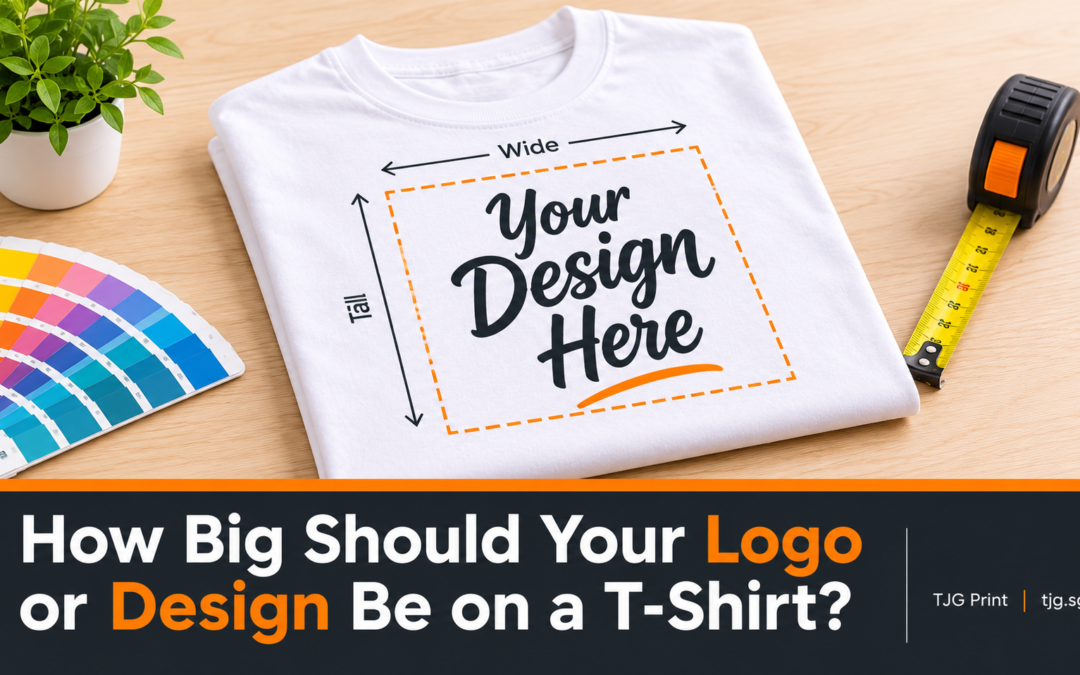
Your logo and design say a lot about your brand.
Choosing the right T-shirt logo size helps your design look professional and balanced. A small chest logo works well for company uniforms, while a larger front or back print gives event graphics, illustrations, and bold branding more room to stand out.
The ideal size depends on your print placement, artwork details, and T-shirt size. In this guide, we’ll cover recommended T-shirt logo dimensions, placement tips, and printing considerations to help you prepare your artwork for TJG Print in Singapore.
Quick T-shirt logo and design size guide
Not sure which size to choose? Here’s a simple guide to get you started:
- Left chest logo: about 6–13 cm wide (2.5–5 in)
- Center chest design: about 15–25 cm wide (6–10 in)
- Full front design: about 25–30 cm wide (10–12 in)
- Back design: about 25–36 cm wide (10–14 in)
- Sleeve logo: about 2.5–10 cm (1–4 in)
Your final size depends on the points below.
|
Placement |
Typical width × height |
Best for |
|
Left chest |
6–13 cm × 6–13 cm (2.5–5 in) |
Company logos, staff uniforms, small icons |
|
Centre chest |
15–25 cm × 15–20 cm (6–10 in × 6–8 in) |
Slogans, wide logos, event names |
|
Full front |
25–30 cm × 25–36 cm (10–12 in × 10–14 in) |
Class tees, event shirts, bold artwork |
|
Oversize front |
30–38 cm × 30–41 cm (12–15 in × 12–16 in) |
Streetwear, large graphics with space around them |
|
Upper back |
25–36 cm × 3–15 cm (10–14 in × 1–6 in) |
Team names, sponsor lines, a simple logo |
|
Full back |
25–36 cm × 15–38 cm (10–14 in × 6–15 in) |
Names and numbers, large artwork, group event designs |
|
Sleeve |
2.5–10 cm (1–4 in) |
Small logos, flags, secondary branding |
Note: These are starting points, not fixed printing rules. Your printer may have different maximum print areas depending on the T-shirt, printing process, and size range. For example, Printful lists a maximum left-chest embroidery area of about 10 × 10 cm (4 × 4 inches).
Check the Size on Paper (Tip)
- Take a normal A4 sheet of paper. It measures 21 × 29.7 cm, a size set by the ISO 216 paper standard. Place it against the T-shirt to get an idea of print size.
- Hold the sheet against the front of the shirt to know how much space the design will take up.
- For a smaller left-chest logo, use only part of the sheet to compare the size.
This simple test can help you decide whether your design looks too small, too large, or about right before you send it for printing.
You may see “A4 silkscreen print” when comparing T-shirt printing options in Singapore. For example, TJG’s Comfy Soft Cotton Round Neck T-Shirt lists a one-color A4 print as part of the product pricing. If you need a larger print, such as an A3 design, mention it when requesting a quote so that we can price it properly.
For a Singapore order, always confirm the actual printable area with your printer before finalizing the artwork.
1. What is the best logo size for T-shirts?
If you are printing a simple company logo, a small or medium chest print is usually enough to make the brand easy to recognize.
A logo around 9 × 7 cm can be a good starting point for a company uniform. It keeps the branding visible without taking up too much space. However, the ideal size depends on the logo’s proportions, lettering, and placement.
This size works well for:
- Company uniforms
- Staff T-shirts
- School or organization shirts
- Event crew shirts
- F&B teams
- Corporate merchandise
- Sports teams
However, do not force every logo into the same size. Look at the logo shape, text, and details because all factors affect how large it needs to be on the T-shirt.
A simple rule
Simple logo = smaller print can work.
Detailed logo = give it more space.
Note: A small print can’t carry fine lines, long taglines, or tiny text. If your logo has a thin outline or a three-line address, use a bigger placement or simplify the version you print.
For polos and caps, we usually suggest embroidery. It gives a raised, neat finish, but thread needs room so that small details can fill in.
2. How big should a T-shirt design be for the full front?
If you are printing an illustration, event graphic, or campaign design, you will usually need more space than a small chest logo.
|
Design type |
Starting size |
|
Standard front print |
10–12 in wide |
|
Large front graphic |
12 × 16 in |
|
Wide horizontal logo |
11 × 5 in |
The print size should match the shape and purpose of your design. A tall illustration may need a taller print area, while a wide logo may look better in a wider, shorter space. Also check how much space is around the artwork, because a file can be large even when the artwork inside it takes up very little space.
3. Front T-shirt logo size: left chest vs center chest
Different placements need different sizes.
|
Placement |
Starting size |
Suitable for |
|
Left chest |
3–4 in wide |
Company logos, uniforms, subtle branding |
|
Centre chest |
4–6 in wide |
School shirts, clubs, small event graphics, short slogans, personalised designs |
4. How big should the back T-shirt design be?
The back of a T-shirt has a larger and more open printable area compared to the chest or sleeve. So, you can use larger logos, text, or detailed designs for designs that need to be larger or contain more information. For example, event names, sponsors, team names, large illustrations, company campaigns, school activities, volunteer groups, and staff roles.
A 10–12-inch-wide logo can be a practical starting point for the back of a T-shirt, giving the design enough space to carry the main message.
For a larger graphic, you can work towards a 12 × 16-inch print area if the shirt and printing method allow it.
Example:
Front: 3–4-inch company logo
Back: 10–12-inch event or campaign design
5. T-shirt logo placement matters as much as size
A right-sized logo can still look unbalanced if it is placed too high, too low, too far to one side, or too close to another design element.
For front artwork, avoid placing the design too close to the collar because it looks cramped and uncomfortable when the person wears the shirt.
For a large front design, recommends positioning the print roughly 6–13 cm below the collar, with adjustments based on shirt size.
T-shirt logo placement is very important because T-shirts do not all have the same design:
- Collar shape
- Chest width
- Cut
- Fabric stretch
- Seam position
- Adult-to-youth proportions
6. Your logo shape affects the right size
Width alone cannot determine the right logo size. The logo’s shape, height, text, and details also affect how it looks on a T-shirt.
|
Logo |
Shape |
Size Consideration |
|
A |
Wide company name |
More width, less height |
|
B |
Circular badge |
More balanced height |
|
C |
Tall symbol + text |
More height for readability |
Right T-Shirt Printing Method for Your Design
The best printing method depends on your artwork, fabric, colour requirements, and order quantity.
Silkscreen printing is often a practical option for bulk orders with simpler designs, while DTF printing can accommodate detailed, multi-colour artwork. Sublimation Printing is commonly used for suitable polyester garments, and embroidery works well for logos that can be reproduced clearly with thread.
Tip: Don’t choose the design size first and the printing method later. Check both together to make sure the artwork looks good and fits your budget.
How Does the T-Shirt Logo Printing Process Work?
Once the size is confirmed, TJG Print follows a simple process to prepare your artwork, review the design, and move the approved order into production.
- Create your design: Prepare your logo or T-shirt artwork and decide on the T-shirt style, color, design, and quantity. TJG Print offers a shirt catalog that includes both cotton and Dri-Fit options, and its minimum quantity starts at 10 pieces.
- Submit an inquiry: Tell the TJG Print team your preferred T-shirt type, quantity, design, and deadline. You can discuss available customization methods, such as silkscreen, DTF, sublimation , embroidery, or heat transfer.
- Submit your artwork: Send your logo or design in an accepted format such as AI, PNG, or PDF. TJG Print recommends high-resolution artwork of at least 300 dpi for print quality.
- Review the digital mock-up: TJG Print in Singapore provides a digital mock-up showing how your design will look on the selected apparel.
- Approve the artwork and order: Once you approve the artwork and the required deposit is made, TJG Print proceeds with the order. (The company states that no further amendments can be made after artwork confirmation, so this is the key stage to check your final logo size.)
- Printing or embroidery begins: After approval, the TJG Print team proceeds with the selected printing or embroidery method.
- Collection or delivery: Once production is complete, your custom T-shirts are prepared for collection or delivery according to your chosen option.
Think about Singapore’s Climate & How the Shirt Will be Used
A T-shirt for an indoor corporate event is not necessarily the same as one for an outdoor activity.
Because Singapore’s weather is based on a tropical climate and with the Equator just 1.5 degrees south, days are generally sunny and seasons are less distinct.
Although rainfall is experienced almost daily, showers are sudden and heavy but short-lived. The wettest period is usually from November to January, during the Northeast Monsoon.
With a warm and humid climate, fabric choice can influence how the finished design looks and feels. TJG’s Dri-Fit range, for example, includes moisture-wicking options designed for Singapore’s climate and is used for corporate events, schools, and sports clubs.
If the shirt will be worn for:
- Sports
- Outdoor events
- School activities
- Team-building days
- F&B work
- Long events
Consider the garment and printing method together rather than choosing the artwork size in isolation.
Find the Right T-Shirt Logo Size for Your Order
Not sure whether your design should be a small logo, A4, or A3?
- For a simple front T-shirt logo, start around 3–4 inches wide.
- For a center-chest graphic, 15–25 cm can work well.
- For a larger front or back design, 10–12 inches wide is a useful starting range, while a full-front design may work around 12 × 16 inches, depending on the garment and printer.
However, there is no magic best logo size for T-shirts.
At TJG Print, we’ve been providing custom T-shirt printing options Singapore businesses, schools, event organizers, and teams since 2015. With more than 700 customizable products and printing options including silkscreen, DTF, sublimation, and embroidery, our team recommends submitting high-resolution printing files of at least 300 dpi and provides a digital mock-up for approval before production.
You can see more of our work in our portfolio gallery.
Send us your logo or design, your quantity, and your deadline. We’ll recommend the size, placement, and print method, and give you a clear quote.
People Also Ask
What is the standard size for a logo on a t-shirt?
There’s no fixed size because it depends on placement. A left chest logo is usually 6-13 cm wide (2.5-5 in), and a center chest design is about 15-25 cm wide.
How wide should a front T-shirt design be?
For a full front print, design about 25-30 cm wide (10-12 in). If you want something neater, a center chest print of around 20 cm works well.
What size should a back print be on a t-shirt?
Most full back prints are about 25-36 cm wide (10-14 in). The height depends on the design, from a short team name line to a full back graphic.
Does the ideal print size change for different T-shirt sizes?
Yes, since the same print looks bigger on a small shirt than on a large one. For mixed groups like kids and adults, a slightly smaller print on the smallest sizes can look more balanced.
How do I choose the right size for a chest or sleeve logo?
Simple logos can go small, but detailed ones need more space. Use 6- 13 cm for the left chest and keep sleeve logos to 2.5- 10 cm. To check, temporarily attach the design/logo to a T-shirt using tape.