
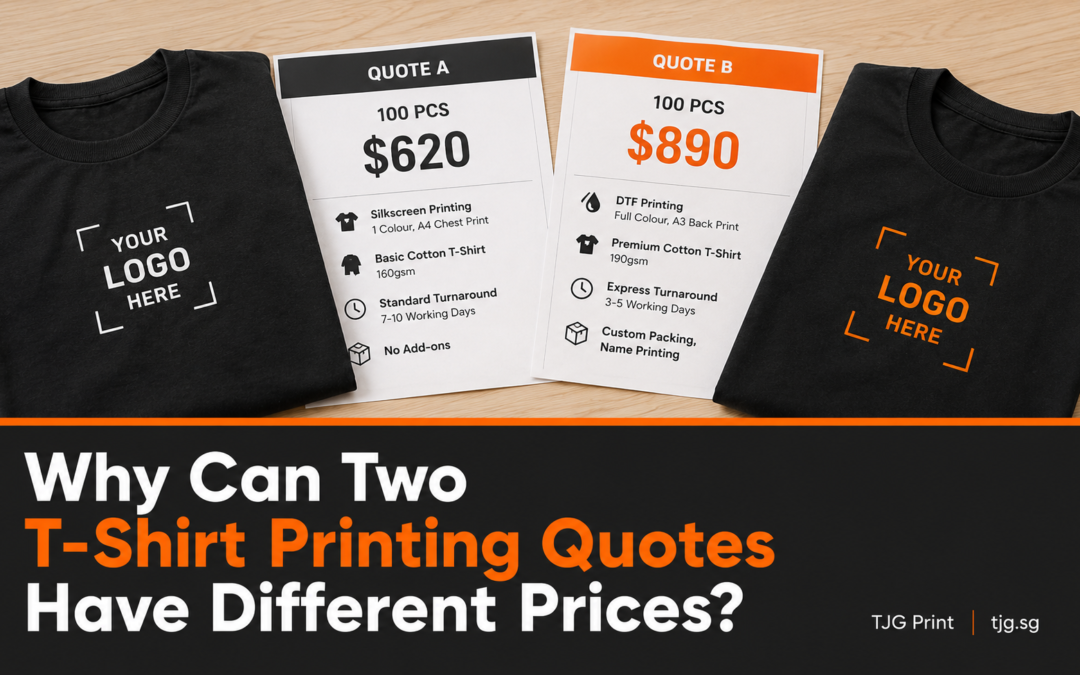
Two T-shirt printing quotes for the same order can look wildly different, and that can feel confusing when you are just trying to pick a supplier. Say you are ordering 100 shirts for a school carnival. One quote comes in at $620, another at $890, and a third somewhere in between.
Nobody is necessarily overcharging you. The quotes are often describing different shirts, different print methods and different levels of printing services. This guide breaks down why, so you can compare fairly.
Why T-Shirt Printing Quotes Differ
A printing quote is not a single price for “100 shirts with a logo.” It is a bundle of choices.
Those choices include the garment, the print method, the artwork, the timeline and the service around it. Change any one of them, and the price changes too.
Here is a quick view of the main factors:
|
Factor |
Why it changes the price |
|
Printing method |
Each method has different setup and production costs |
|
Quantity |
Larger orders spread setup costs across more pieces |
|
Garment quality |
Fabric, weight and cut affect the base cost |
|
Artwork |
More colors, larger prints and more placements cost more |
|
Turnaround time |
Rush jobs need priority production |
|
Extras |
Sizes, names, packing and delivery may be added on |
Now let’s look at each one in detail.
1. The Printing Method
Different methods suit different designs, and they are priced differently.
Silkscreen printing
Silkscreen is a popular choice for bulk orders with simple designs. Each color needs its own screen, so a one-color logo is much cheaper than a five-color design.
DTF printing
DTF (direct-to-film) handles detailed, multicolor artwork well. It is often a good fit for complex designs or smaller runs where making many screens would not make sense.
Dye sublimation
Sublimation is used for polyester, such as sports jerseys and Dri Fit shirts. It allows full-color designs that cover the entire garment.
Embroidery
Embroidery is stitched rather than printed, so pricing usually depends on stitch count and design size. It suits polos, jackets and corporate wear.
Heat transfer vinyl
This works well for names and numbers on team shirts. It is practical for small personalized details.
If one quote assumes silkscreen and another assumes DTF, the price gap may simply reflect the method.
2. The Quantity
Quantity is one of the biggest price drivers.
Every print job has setup work, such as preparing screens or files. When you order more shirts, that setup cost is shared across more pieces, so each shirt costs less.
For example, TJG Print lists its Dri Fit T-shirt from $5.20 per piece at 100 pieces with a one-color A4 silkscreen print. At smaller quantities, the per-piece price is typically higher.
Always check what quantity each quote is based on. A quote for 100 pieces and a quote for 50 pieces are not comparable.
3. The Garment Type and Quality
Not all blank shirts are the same, even when they look alike on a product page.
Differences to look for:
- Fabric: Cotton, polyester and blends feel and perform differently.
- Weight: Heavier fabric usually costs more. Our guide to T-shirt GSM explains how weight affects feel and price.
- Cut and fit: Regular, slim and oversized styles use different amounts of material.
- Brand and finish: Softness, durability and shrinkage resistance vary between suppliers.
A low quote may use a thinner or lower-grade shirt. It might look fine on day one and feel very different after a few washes.
4. The Artwork and Print Details
Your design affects the price more than most people expect.
Things that raise or lower cost:
- Number of colors. More colors usually means more setup, especially with silkscreen.
- Print size. A small chest logo costs less than a large A3 back print.
- Number of placements. Front, back, sleeve and neck prints each add work.
- Artwork readiness. Clean, print-ready files save time. Files that need redrawing may add a design fee.
Ask each supplier what print size and number of colors their quote covers. Two quotes can look different simply because one assumed a small logo and the other assumed a full-chest print.
5. Setup, Mockup and Design Fees
Some quotes include setup and design work in the price. Others list them separately, or add them later.
Common examples include:
- Screen or film setup
- Artwork cleanup or vectorizing
- Digital mockups and revisions
- Sample or proof approval
None of these are unreasonable. The problem is when they appear as a surprise. A fair quote tells you upfront what is included.
6. Sizes, Names and Add-Ons
Small details can quietly change the total.
Watch for:
- Size surcharges. Some suppliers charge more for larger sizes such as 3XL or above. TJG allows mixed sizes at the same price per piece for the same design.
- Names and numbers. Personalization usually costs extra per piece.
- Custom tags, folding and individual packing. These add labor.
- Multiple designs. Each design may be treated as its own print job.
If a quote looks unusually low, check whether these are left out.
7. The Turnaround Time
Speed has a price.
Standard production schedules let the printer plan work efficiently. Rush orders need priority space on the production line, and that usually costs more.
As a guide, TJG’s silkscreen, DTF and heat transfer jobs take 10 days or less, and embroidery takes 14 days or less. Rush options can be available in a few days, depending on the job.
When comparing quotes, confirm that each one is based on the same delivery date.
8. Delivery and Logistics
Delivery is easy to forget until the final invoice.
Some quotes include it. Others add it as a separate line, or only mention it at checkout. At TJG, delivery is free for orders of 500 pieces or more, and starts from $15 for smaller orders. Self-collection is also available.
A quote that excludes delivery can look cheaper than one that includes it, even when the final cost is the same.
9. Service, Reliability and Experience
Price is only one part of value.
Consider what comes with the quote:
- Do they give clear, itemized pricing?
- Will you see a mockup before production?
- Can you view a physical sample?
- How quickly do they reply to messages?
- Do they have experience with schools, companies and government projects?
A custom t-shirts supplier who answers questions clearly and delivers on time can save you far more than a small price difference. For organizations that buy through procurement systems, being registered on platforms such as GeBIZ and Vendors@Gov can also matter.
How to Compare Two Quotes Fairly
Once you understand the factors, comparing becomes much easier. Use this checklist:
- Match the quantity: Compare quotes for the same number of pieces.
- Match the garment: Confirm the style, fabric and weight.
- Match the print: Check the method, size, colors and placements.
- Check inclusions: Look for setup, mockup, packing and delivery.
- Confirm the timeline: Make sure the delivery date is the same.
- Ask for the total: Request the final amount, not just the unit price.
- Ask about extra charges: Ask directly about size surcharges and revision fees.
If you can lay quotes side by side and everything above matches, any remaining price gap is usually about quality and service.
Hidden Costs to Watch For
Here are common items that appear later in the process:
- Setup or screen fees listed separately
- Charges for artwork changes or extra revisions
- Surcharges for larger sizes
- Extra fees for additional print colors or placements
- Delivery charges
- Rush fees if your timeline shifts
Ask for a written, itemized quote. It is the simplest way to avoid surprises.
Is the Cheapest Quote Always the Best?
Not always, and not always the worst either.
A low quote can be of great value if it matches your needs. It becomes a problem when it uses a thinner shirt, skips the proof, or leaves out costs that show up later.
The better question is, “What exactly am I getting for this price?” Once you can answer that, the right choice is usually clear.
Conclusion
Quotes differ because the details behind them differ. The print method, quantity, garment, artwork, timeline and service all shape the number at the bottom.
If you would like a clear, itemized quote, TJG is happy to help. Send us your design, quantity and event date through our website, by email at sales@tjg.sg, or by WhatsApp at +65 8774 0792, and we will walk you through every line so you can compare T-shirt printing quotes with confidence.
Frequently Asked Questions
1. Why do different t-shirt printing companies charge different prices for the same order?
Because the orders are rarely truly identical. Companies may quote different garments, print methods, print sizes, turnaround times and service levels. Some also include setup, mockups and delivery, while others charge for them separately.
2. What factors affect the cost of custom t-shirt printing?
The main factors are the printing method, quantity, garment quality, number of colors, print size and placement. Turnaround time, personalization, packing and delivery also affect the final price.
3. Is a cheaper t-shirt printing quote always the better option?
Not necessarily. A cheaper quote may use lighter fabric, fewer inclusions or a longer timeline. Compare the full details first, then decide based on overall value.
4. How does the printing method affect the price of custom t-shirts?
Each method has different setup and production costs. Silkscreen is usually economical for larger orders with few colors, DTF suits detailed multicolor designs, sublimation is used for polyester, and embroidery is priced by stitch count and size.
5. What should I check before accepting a t-shirt printing quote?
Confirm the quantity, garment type, print method, print size, number of colors, turnaround time and delivery cost. Ask whether setup, mockups and size surcharges are included, and request an itemized total in writing.